| Truth in Media Global Watch Bulletins |
|
TiM GW Bulletin 2002/12-3 Dec 16, 2002 |
About Lou Gerstner's Book "Who Says Elephants Can't Dance?" IBM's Gerstner Spills the Beans... Unwittingly Boasting about IBM Directors’ Courtship in 1992, He Reveals How IBM Board Misled the Public; Off to Carlyle Group Post |

FROM PHOENIX, ARIZONA GLOBAL
AFFAIRS
GLOBAL
AFFAIRS
HIGHLIGHTS
Phoenix 1. IBM's Gerstner Spills the Beans... Unwittingly
Phoenix 2. Gerstner Off to Carlyle Group Post

About Lou Gerstner's Book "Who Says Elephants Can't Dance?"
1. IBM's Gerstner Spills the Beans... Unwittingly
Boasting about IBM Directors’ Courtship in 1992, He Reveals How IBM Board Misled the Public
PHOENIX,
Dec 13 - Perhaps the most remarkable thing about Lou Gerstner’s book
(“Who Says Elephants Can’t Dance?”, HarperCollins) is that the
author, a former IBM CEO and chairman, unwittingly spills the beans about
the inner workings of the “old boys network” that staffs and runs
America’s corporate boards.
The
second most remarkable thing is that Gerstner’s “Book Description” cites some wrong facts about IBM.
In its first sentence! (see the chart and comment on page 5).
Description” cites some wrong facts about IBM.
In its first sentence! (see the chart and comment on page 5).
We
say “unwittingly,” because Gerstner spilled the beans in passing,
while puffing up his own ego and executive star-appeal.
And without realizing perhaps the severity of the disclosures he
was making.
For
example, Gerstner wants his readers to believe that he only reluctantly
accepted the helm of one of the greatest companies in the history of the
world. He
recounts in great detail, the supposed courting and cajoling by James
Burke (“Mr. Tylenol”) and Tom Murphy (Capital City/ABC), the two IBM
directors who led the search for a new CEO after John Akers, Gerstner’s
predecessor, “resigned” on Jan 26, 1993.
Here’s
an excerpt from the Gerstner book about their February 1993 meeting:
In February I met with Burke and his fellow search committee member, Tom Murphy, then CEO of Cap Cities/ABC. Jim made an emphatic, even passionate pitch that the board was not looking for a technologist, but rather a broad-based leader and change agent.
"…What is critically important is the person must be a proven, effective leader -- one who is skilled at generating and managing change."
Once again, I told Burke
and Murphy that I really did not feel qualified for the position and that
I did not want to proceed any further with the process.
So what’s wrong with Gerstner being courted
by members of IBM Board’s “search committee?”
Nothing. Except that
the books reveals that first IBM-related meeting between Burke and
Gerstner reportedly took place at Gerstner’s “execupad” (a luxury
Manhattan apartment with concierge services) on
December 14, 1992.
The date is very
significant. Although we
(Annex) had been publicly calling for both Akers and/or the IBM Board to
resign for over 18 months (see “Akers:
The Last Emperor?”, June 1991), Burke and other IBM Board members
had been on the record as saying that they fully supported Akers as
chairman and CEO.
Here’s, for example, what Burke told the Wall
Street Journal on Dec. 1, 1992, only two weeks prior to courting
Gerstner about the top IBM job:
"I
wouldn't know how to put somebody in who could do better, from inside or
outside the company," declares Mr. Burke, who is quietly emerging as
the leader of IBM 's outside directors and is thus far delivering their
solid support to Mr. Akers.
In
fact, Burke went out of his way to defend Akers, publicly anyway.
Here’s what he also told the Journal in the same interview:
Indeed,
Mr. Burke says he has wondered whether Mr. Akers is cutting too deeply.
"This company is an extraordinary national asset on the cutting edge
of what is changing the world," Mr. Burke says. "Let's make sure
that we don't throw the baby out with the bath water."
Yet
just a few months later, Burke (still on the IBM Board back then) and
other IBM directors approved the biggest-ever quarterly cuts in IBM
history… implemented by Gerstner! ($8.9 billion - see Annex Bulletin
93-40, July 27, 1993).
Nor
was Burke alone in publicly voicing his support for Gerstner.
Irving Shapiro, for example, a former IBM board member, was quoted in a recent (1991) interview with Business Week as saying, "I applaud what IBM is doing. The only issue is: How productive is it?"
Richard Lyman, an old-timer on
the IBM board (since 1978) and a former president of Stanford University,
said that Akers has "the full confidence of the board."
So Burke, “IBM’s most powerful outside director” in December 1992, according to the Journal, was speaking for the Board when he praised Akers. Here’s what that story also concluded:
…other outside directors won't
comment, but they're considered likely to fall in line behind Mr. Burke.
In short, Burke et. al. mislead the public!
Well, that may seem like small potatoes in the
post-Enron era, after travesties worse than lying by Ken Lay (Enron) and
others (WorldCom, Andersen, etc.) came to light. But back in 1992, IBM still had a pristine image.
IBM was still lily white-kind of Big Blue, earned over the decades
of high morality leadership by the two Presbyterian Watson’s (the IBM
“founder” and his son).
Had the public and the Wall Street investors known that Burke and the IBM Board were talking out of both sides of their mouths, they might have fled out of the IBM stock even sooner and in greater numbers than they actually did (see the stock chart).

But
there is more…
Double Jeopardy?
We
have it on pretty good authority that Akers was actually told by the IBM
directors that he would have to go at the Board meeting in Japan in
October 1992.
How
good an authority? As good as
it gets. IBM’s current CEO,
Sam Palmisano, told us that during a dinner conversation in November 1994.
And he should know. Not
only because he is now Big Blue’s big boss.
But because Palmisano had been also Akers’ EA (Executive
Assistant), and was in Japan at the time of that October 1992 Board
meeting.
Here’s
an excerpt from this writer’s November 3, 1994 diary notes, now being
published for the first time:
John Akers, IBM Board
Sam had been Akers' EA for two years.
That's unusual. Typically,
EA'sare kept less than a year on the job, before being dispatched
somewhere back to the field. "I
guess
I was
a slow learner," Sam joked.
Far from it, he and Akers have become very close. Which is why Akers kept him around for so long. And even now, the two maintain a close personal relationship. "I was out playing golf with John on Sunday (10/30/94)," Sam said.
I used that chance to say in front of
another consultant that, "Akers was really a nice guy who had lost
his compass " (this was actually the headline from our last report
about Akers - see “A
Nice Guy Who Lost His Compass,” Annex Bulletin 93-07, Jan 26, 1993).
And that the IBM Board directors treated him very shabbily.
I figured that this message would eventually filter back to Akers,
too.
That's when Sam Palmisano opened up.
He told us what happened at the IBM October 1992 Board meeting,
which took place in Tokyo. At
the time, Palmisano was also based in Tokyo, working for IBM Japan (as
distinct from IBM Asia/Pacific HQ which Ned Lautenbach was heading up at
the time).
"I noticed that something was wrong
when I talked to Susan (Akers' wife), after the Board meeting ended,"
Sam said. "She was very
upset." Akers' luck with
the Board had evidently run out.
"That's incredible!" I said.
"I remember Akers holding a news conference in mid-December
(i.e., two months later!) in New York (to announce big write-offs), and
assuring the world that the Board had full confidence in him."
I added that some IBM Board members (e.g., Opel, Burke) were also
quoted in the WALL STREET JOURNAL in late November/early December (1992) about how
much they supported what Akers was doing.
"That means that they simply lied and
deliberately deceived the public!" I said. "I can't believe it!
They are worse than even I had thought before."
Should
the SEC look into it now that Gerstner has spilled the beans and
independently corroborated a part of the (old) IBM Board’s deception?
Why
not? As far as we know, there
is no “statute of limitations” on lying.
Or on a public Board misleading the public.
Such a case may just be the right kind of a challenge for the
just-appointed SEC chairman, William H. Donaldson, if he is to establish
credibility as a tough law enforcer.
This
may be all the more appropriate as our initial call for Akers’
resignation and criticism of the IBM Board’s complacency (“Akers:
The Last Emperor?”, June 1991), had
been sent to the then SEC chairman and to ALL
IBM OUTSIDE DIRECTORS, and to the chairmen of the banks and large
institutions that owned the biggest chunks of the IBM stock in 1991.
Having
told Akers in October 1992 that he was basically finished, it was more
than preposterous for the IBM Board and other insiders to try to make us
believe that Akers suddenly voluntarily resigned on Jan 26, 1993.
“Akers Quits at IBM under Heavy
Pressure,” for example, was the Wall Street Journal headline on Jan
27, 1993.
Here’s
what we said about that momentous Big Blue moment in an editorial written
the same day (see “A
Nice Guy Who Lost His Compass,” Jan 26, 1993):
…Only 24 hours after supposedly giving "full support" to the company's CEO, according to IBM's PR department, (the IBM Board) gave John Akers a well-deserved boot. At least three to eight years late, the IBM Board members were among the last to admit that the "emperor had no clothes."
…if someone were to suggest to
you that John Akers voluntarily
resigned a mere 24 hours after "everyone in sight" at IBM denied
the rumors which we have been hearing about twice a day for the last three
weeks about his resignation; we hope that you would dismiss such
suggestions as -- sheer nonsense. Akers
was no more the resigning kind than was Gorbachev, or Milosevic.
People like that have to be pushed out.
He was.
Good Manager, Poor Entrepreneur, Wrong
Facts
As
for the new IBM CEO, the search for whom was only beginning back then (or
so we thought), here’s what we said contemporaneously about that:
… A good time for IBM's shareholders, customers, or employees to rejoice? It is not. It is a time for careful reflection; a time to weigh the options which will shape the IBM future.
… The new IBM CEO, therefore,
needn't necessarily know which end of a 3090 mainframe is up, nor the
difference between the DRAMs and the LA RAMs. This
person needn't come from within the computer industry, which would ensure
that he or she would not be tempted to meddle in operational management.
This person should be a "business architect" with
financial, legal and political skills to match the challenge of disposing
of a tremendous amount of IBM's current assets, or acquiring some news
ones down stream.
As it turned out, in Lou Gerstner, IBM got a
mechanic instead of an architect; a CEO who knew how to cut but not how to
grow (see “Gerstner’s
Legacy: Good Manager, Poor Entrepreneur,” Jan 29,
2002).
And now, a full decade after he was first
approached about the IBM job, we can see that Gerstner still doesn’t
have all his Big Blue ducks in order.
The first sentence of Gerstner’s “Book Description,” which is
also the first sentence of the book’s inside jacket, contains wrong
facts:
“In 1990, IBM had its most profitable year
ever….”
Actually, IBM had more profitable years in 1984 and 1985 - in terms of absolute net profit figures; and in five (5) other years (1984-1988), when it had higher net margins (see the chart).

Oh
well, what’s a billion here, a billion
there... if you’re a “Louis
XIX of Armonk?” J Hopefully,
the former Big Blue emperor has a better grasp of his own executive
compensation. As you saw in “Sir
Lou OutLayed Lay” (April 2002), Gerstner outdid even the Enron
chairman in insider selling. With
the help of the (new) IBM Board members - his pals whom he had appointed,
the former IBM CEO took home nearly half a billion dollars in aggregate
executive compensation.
Gerstner’s nine years at the IBM helm will be
remembered as the “Era of Greed.”
They are unprecedented in IBM corporate history when it comes to
plutocratic self-dealing by the top Big Blue brass.
But that’s not
something about which Gerstner is boasting in his book “Who Says
Elephants Can’t Dance?” Self-enrichment
while manipulating the stock through stock buybacks is another
conflict-of-interest practice that the new SEC chairman may want to look
into. If he really means
business, that is.
But don’t hold your breath for it to happen
any time soon. The chances of his and/or IBM Board’s apparent
transgressions being investigated by the SEC or other branches of our
government are pretty slim. At
least if history is the guidepost and the status quo prevails.
Oh, well… at least IBM now has at its helm a CEO with a “nice guy” image. With Gerstner gone, we should see shortly in which direction Palmisano steers the Big Blue ship. If he does have some real changes up his sleeve, he’d better show them soon.
Returning to IBM’s old morality may not be a bad start.
2. Gerstner Off to Carlyle Group Post
PHOENIX, Dec 13 - While
still collecting hefty “consulting” and “retirement” compensation
from IBM, Lou Gerstner is already off to greener pastures.
CNN reported on Nov 27 that the former Big Blue CEO had accepted a
position as the chairman of the privately held Carlyle Group, a No.
11 defense contractor on Pentagon’s top 50 list.
Carlyle Group is closely tied to the Bush family, among others.
The company has been accused in the past of peddling influence for
profit.
George
Bush Sr., for example, is an “advisor” who makes speeches on behalf of
Carlyle. Jim Baker, former
Bush Sr.’s former Chief of Staff and Secretary of State, is a “senior
counselor.” John Major,
former British prime minister, is chairman of Carlyle Europe.
The firm also employs the former SEC chairman, Arthur Levitt, and
the former FCC chairman, William Kennard.
Just some among its many “stars”…
Gerstner
succeeds in the Carlyle chairman post Frank Carlucci, a former secretary
of defense under President Reagan. The
company was founded in 1987 by Stephen Norris, a former Marriott
executive, and by David Rubenstein, a former White House aide to President
Carter. Today, Carlyle is one
of the largest private equity firms in the world.
It has 550 investors and $13.9 billion in assets under management,
according to CNN Money.
As
of late 2001, Carlyle investors even included the Saudi bin Laden family,
according to a Wall Street Journal Sep 28, 2001 story ("Bin
Laden Family Could Profit From a Jump In Defense Spending Due to Ties to
U.S. Bank"):
A Carlyle executive said the bin Laden family committed $2 million through a London investment arm in 1995 in Carlyle Partners II Fund, which raised $1.3 billion overall. The fund has purchased several aerospace companies among 29 deals. So far, the family has received $1.3 million back in completed investments and should ultimately realize a 40% annualized rate of return, the Carlyle executive said.
But a foreign financier with
ties to the bin Laden family says the family's overall investment with
Carlyle is considerably larger. He called the $2 million merely an initial
contribution. "It's like plowing a field," this person said.
"You seed it once. You plow it, and then you reseed it again."
No
wonder scores of big names of American politics have made a pilgrimage
over the years to the bin Laden compound in Saudi Arabia in pursuit of
donations or investments. And not just the Republicans.
Former
President Carter, for example, met with 10 of Osama's brothers early in
2000 on a fund-raising trip for the Carter Center in Atlanta, the
Journal reported.
John
Hardman, executive director of the center, was quoted as saying that the
brothers told Carter that Osama was completely removed from the family.
After Carter and his wife followed up with breakfast with Bakr bin
Laden in New York in September 2000, the bin Laden family gave $200,000 to
the center.
After
9/11, however, various Carlyle Group associates tried to disassociate
themselves from the bin Laden’s (quoting from the
Journal):
Former President Bush said through his chief of staff, Jean Becker, that he recalled only one meeting with the bin Laden family, which took place in November 1998. Ms. Becker confirmed that there was a second meeting in January 2000, after being read the ex-president's subsequent thank-you note. "President Bush does not have a relationship with the bin Laden family," says Ms. Becker. "He's met them twice."
Mr. Baker visited the bin Laden
family in both 1998 and 1999, according to people close to the family. In
the second trip, he traveled on a family plane. Mr. Baker declined
comment, as did Mr. Carlucci, a past chairman of Nortel Networks Corp.,
which has partnered with Saudi Binladin Group on telecommunications
ventures.
Gerstner’s appointment as chairman of the Carlyle Group shows he is well plugged into the highest levels of the New World Order plutocracy (he is also a member of the Council on Foreign Relations, of the Bilderbergers Group, and of the Trilateral Commission).
Also
click here for an Index
of 911-related articles ...
here for an Index
of 911-related articles ...
Such as…
"Greed Bites Back," "Wall Street Casino Revisited", "Dirty
Tricks with Dirty Bombs", "Repressing
White Americans Through Rampant Immigration",
"Plutocrats of the World
Unite," "Bush
League All-Stars," “Enronizing
Pretzelitis:” New Alzheimer Strain Strikes Potus Potatus Primus
Plus... Stitching
Together the New World Order Flag 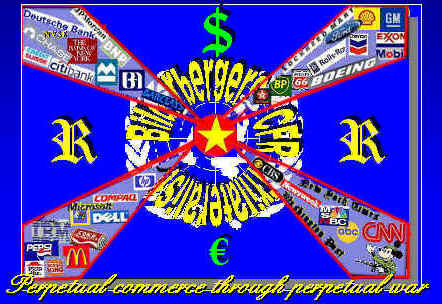
and for others on Global Affairs.
---


Also, check out... Djurdjevic's CHRONICLES magazine columns: "ON THE BRINK OF MADNESS", "A BEAR IN SHEEP'S CLOTHING", "WALL STREET BOOM, MAIN STREET DOOM", "PERPETUAL WAR FOR PERPETUAL COMMERCE", "WIPING OUT THE MIDDLE CLASS", "WALL STREET'S FINANCIAL TERRORISM"
Or Djurdjevic's WASHINGTON TIMES columns: "Christianity Under Siege," "Silence Over Persecuted Christians", "Chinese Dragon Wagging Macedonian Tail," "An Ugly Double Standard in Kosovo Conflict?", "NATO's Bullyboys", "Kosovo: Why Are We Involved?", and "Ginning Up Another Crisis"
Or Djurdjevic's NEW DAWN (Australia) magazine columns: "Macedonia: Another Farcical American Oil War," "Anti-Christian Crusades," "Blood for Oil, Drugs for Arms", "Washington's Crisis Factory," and "New Iron Curtain Over Europe"