| Truth in Media Global Watch Bulletins |
TiM GW Bulletin 2001/8-2 August 15, 2001 |
An Essay by a Canadian Documentary Filmmaker Truth Buried in Balkan Hell Holes Also, "What Were We Bombed For?" - Belgrade reader says lack of evidence cited by the Hague over Milosevic's alleged Kosovo crimes, yet NATO went to war with Serbia because of them!? |

FROM PHOENIX, ARIZONA BALKAN
AFFAIRS
BALKAN
AFFAIRS
HEADLINES
Calgary
1.
Truth Buried in Balkan Hell Holes (by Garth Pritchard)
Belgrade 2. “What Were We Bombed For?” - an Update to
TiM Readers Forum - TiM Bulletin 2001/8-1
Phoenix
FOREWORD:
Albanian Terrorists’ Proxies Aug.
17, 2001
Aug.
17, 2001
Skopje
3.
PR Spinning of Terrorists into “Statesmen”Aug.
17, 2001
Washington
4.
U.S. to Fund Macedonia Media BlitzAug.
17, 2001
Ottawa
5.
“Canadian Trinity:” Ottawa to Send Only Three Soldiers to MacedoniaAug.
17, 2001
Rio de Janeiro 6. Brazilian
Judge Says Hague Tribunal Is “Partial”Aug.
21, 2001
-------------
1.
Truth Buried in Balkan Hell Holes
By Garth Pritchard 
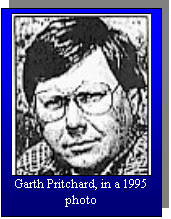 PHOENIX, Aug. 15 - Garth Pritchard is an
award-winning independent Canadian documentary filmmaker. He
has followed Canadian troops, his camera and reporter’s pad in hand,
through all their Balkan peacekeeping missions during the last nine years.
Since 1992, he has been to Bosnia, the Krajina, Croatia, Serbia,
Kosovo, Macedonia… to mention only some of the NWO crime scenes.
PHOENIX, Aug. 15 - Garth Pritchard is an
award-winning independent Canadian documentary filmmaker. He
has followed Canadian troops, his camera and reporter’s pad in hand,
through all their Balkan peacekeeping missions during the last nine years.
Since 1992, he has been to Bosnia, the Krajina, Croatia, Serbia,
Kosovo, Macedonia… to mention only some of the NWO crime scenes.
“I’ve crisscrossed every nook and cranny of that country,” Pritchard told the TiM editor today, as he described some of the scenes he has seen during his seven trips to what is now known as “former Yugoslavia.”
As a result, Pritchard has seen what the New World Order hell holes look like - from the inside - the way a soldier or a victim would see them. Unlike the American public, which is being led down the garden path blindfolded by CNN’s and other NWO establishment media’s lies and distortions, at least some Canadians have had a chance to see the other side of the coin, through the stories that Pritchard’s cameras recorded and presented. His latest documentary, “Shadows of War,” for example, has received several awards, he says.
Yet even in Canada, the public at large is largely unaware of the truth. Because Pritchard’s films have been ignored by the mass media, including this country’s National Film Board, which sent Pritchard to the Balkans. The truth has been muffled. The cries of the innocent victims have been gagged. Just as in the U.S. and elsewhere in the New World Order lapdog media.
In this TiM Bulletin, however, we bring you with the author’s permission his narrative, “Truth buried in Balkan hell holes.” The article was also published in the print edition only (!) of the Toronto Sun on Aug. 12. Here’s what Pritchard said about some of the atrocities committed by the Croat army against the Serb civilians in the Krajina in 1993 and in 1995:
Truth
lies buried in Balkan hell holes
It
was the classic case of the 100-foot stare in a 10-foot room.
The
dialogue was flat, almost disembodied. But the young soldiers were trying
to speak to the camera. They had been asked what happened in the Medac
pocket in 1993 when Croat forces attacked the Krajina, then held by Serbs.
The
horrors they witnessed were close to unspeakable. The young soldier looked
at the camera lens, and beyond. He remembered what he had seen: "They
(the Croats) were using people from the villages to carry the belongings
they had stolen. We trailed them towards the mountains, and as we got
close, they started to kill people - a warning for us to stop the
chase."
'We
tried our best'
"We
radioed what was happening and were told not to go any further. I'm sorry,
sir. We really didn't know whether or not we got the right body parts in
the right body bags. We tried our best, sir."
The
horrors of the Medac pocket were obvious the day I arrived in the battle
zone. Maybe it was the child's bicycle lying in the mud at the crossroads
- run over by tanks. Or the gutted buildings. But for sure there'd been
horror there. Everything was destroyed. Everything gone. All animals, even
chickens, had been slaughtered. And, of course, the smell.
A
Balkan hell hole. Unreported. It would be two years before the Canadian
media picked up the story and explained that this was the biggest battle
Canadians had been involved in since the Korean War.
Canadians,
under the United Nations, had put a stop to the slaughter of Serbs by the
Croats reputedly under the command of Croat Maj. Gen. Rahim Ademi (an
ethnic Albanian - TiM Ed.), who on July 26, 2001,
gave himself up to the Hague War Crimes Tribunal to face charges of
murder, plunder, wanton destruction and crimes against humanity.
The
general is quoted as saying that his conscience is clear. As a film-maker
following the Canadian involvement, I have covered the Balkans extensively
for years and have always tried to remain impartial. But what happened in
the Medac pocket is beyond most atrocities that I've tried to record,
including the killing fields in Kosovo.
My
conscience is not clear. I covered the Medac pocket and allowed the
National Film Board and other so-called Canadian national news agencies to
turn a blind eye to what happened there.
The
common thread in the Medac pocket and Krajina, is what happened to Serb
civilians. For a reason I can't comprehend, the same yardstick is not
being used by the Canadian media. and now The Hague, to judge Croats as is
used in judging Serbs and Muslims in other parts of the Balkans.
It
appears that evidence of war crimes against Croats in the Krajina has been
lost. So now, Croatian general staff officers are giving themselves up to
the tribunal. Something very strange is under way here.
There
is one absolute in all this: Canadians were involved, and Canadians know
what happened. In 1995, Gen. Alain Forand was in charge of the UN
contingent in the Krajina when the Croats swept through in a five-day
blitzkrieg that displaced 185,000 Serbs. Canadians under his command know
the truth and have tried to speak out. But their voices haven't been
heard.
The
same holds true for the Canadian soldiers at Medac, 1993.
Shelling
of Knin
Canadian
Capt. Phil Berkhoff, now retired, explained to my camera what happened in
the 1995 shelling of Knin. An old lady, holding her dead husband in her
arms, her eye blown out, refused to leave her husband's side as the
captain pleaded with her to go before another mortar attack.
"We
did the best we could," said Capt. Berkhoff. "It was horrible.
These were civilians. We lifted one man to put him in a body bag, and his
brain spilled on my foot.
"We
moved body bags across some grass near a fence, and when we came back
Croat tanks had crossed the grass deliberately and run over the body bags.
We didn't know if these dead were Serb, Croat or Muslim. Neither did the
people in the Croat tanks."
Gen.
Forand and his small contingent of Canadians in Knin saved and protected
780 refugees for two months while the UN called them "displaced
persons" and wanted them released to the street and the Croats.
Forland refused. Not on his watch. Not Rwanda all over again. Not this
time. (See a story
in the TiM
Bulletin 95-13, Oct. 10, 1995, about this, also reproduced here at the
bottom of this article - TiM Ed.).
Knin
was smashed. Civilians were slaughtered. Animals were castrated and shot.
Farms were burned. The Krajina was ethnically cleansed of more than
185,000 human beings whose roots were there for the ages.
What
occurred on the highway that led to Serbia has not been told: An old woman
told me that when her farm was shelled, her son was hit and died in her
arms. She turned to tell her husband that their son was dead, but he was
also dead. Thousands of vehicles littered the landscape, overturned,
burned, shot full of holes. (See
the photo “New
World Order at Work: Exodus of Serbs,” 1995, which has been posted
at our web site since its inception in 1997 - TiM Ed.).
Bullet-riddled
body
Tens
of thousands of little piles of personal belongings lay in the open, some
neatly stacked, others scattered - an old woman sprawled in an ancient
car, her body riddled by a machine-gun; the bodies of a family of farmers,
thrown down the farm's well, probably while they were still alive.
I
documented much of this. The National Film Board and CBC refused any part
of it.
The
Canadian media? To them, the main story at the time was two trailers that
caught fire at a barbecue Canadian military personnel had. Where were the
stories of Canadian soldiers in flak jackets lying on top of people who
had none, to protect them from bombardments going on?
What
happened at Knin's main hospital? I was told the sick were thrown out of
windows, the basement piled high with bodies. Were the Croats given
permission by the UN and United States to attack the Krajina? Where the
hell did all their tanks come from? Who trained the crews?
There
are many Canadians who know the truth. One Canadian, who worked for the
UN, tells of staggering amounts of money paid by him to Croats - in cash.
If a UN contingent needed the Polish tanks for mine clearance, the UN
received an invoice for damage to Croatian roads - again to be paid in
cash.
Unbelievable
amounts of money, always in cash, were paid out to billet UN soldiers in
blown-out buildings. There were monthly meetings, parties, cash paid out.
When UN helicopters landed at Croat airports, cash was handed over for
landing rights.
Were
the Croats told to clean up the evidence of war as soon as possible? For
sure, they were painting the lines back on Krajina's roads within days of
the five-day blitzkrieg. For sure, the UN was saying the Krajina hadn't
been seriously damaged.
In
fact, the main street was destroyed and most of the buildings in town had
been hit by mortar artillery fire. As for the hospital that had bodies
lying around it, thrown from windows - quickly cleaned up. A few days
later it was actually functioning.
In
Knin, as in the Medac pocket, there were unspeakable atrocities. The
Canadian media chose to ignore both events, although thousands of Canadian
soldiers were there. Canadian peacekeepers did not pick sides and saved
thousands of lives. It now appears that all evidence of war crimes has
disappeared - except in the minds of young Canadians who served there.
The
National Film Board of Canada, which sent me there, did not do a
documentary on the Krajina, although I was there with my camera. Instead,
they chose to do a one-hour documentary on ballroom dancing in Germany.
Jeopardize
lives
The
NFB ordered me to give my footage to the War Crimes Tribunal people who I
met in Toronto. I was against this, believing that film-makers should
never give unedited footage to any court without being legally obligated
to do so. Otherwise, I believe we jeopardize the lives of directors and
cameramen who go to the world's war zones.
To
give unedited footage to the War Crimes Tribunal in The Hague without
legal paperwork demanding it is wrong, especially if there's been a
decision not to make it into a documentary for the public consumption.
Today,
evidence of war crimes in the Krajina appears to be missing. Canadians
know the truth, even if there's no documentary showing the results of the
Medac pocket and Krajina. And for this I am truly angry.
Maj.
Gen. Rahim Ademi, the reputed commander of the Croat troops at Medac, may
claim to have a clear conscience.
I
do not.
Garth Pritchard, Calgary, Canada
---
TiM Ed.: So there you have it… an honest account of the truth by a conscientious reporter. A rarity these days. For, as George Orwell put it, "at a time of universal deceit - telling the truth is a revolutionary act." Which makes Pritchard a media revolutionary of sorts.
P.S. An excerpt from the TiM Bulletin 95-13, Oct. 10, 1995:
The Heroes of Krajina
KNIN,
Sep. 18, 1995 - Garth
Pritchard, a director-photographer with a Canadian National Film
Board, paints a touching picture of the heroics displayed by the Canadian
UN peacekeeping unit, the “Van Doos,” who tried to save lives of
nearly 800 Serb civilians from the threat by the would-be Croat
executioners.
The
Serbs were trapped in Knin when Krajina fell in August.
The UN command considered these Serbs mere “displaced persons,”
rather than “refugees,” and declared them ineligible for UN or Red
Cross aid. But not so Gen. Alain Forand and his
Canadians.
“Two
cooks worked around the clock providing (food) for these 780 people,”
writes Pritchard in the Sept. 18 edition of the TORONTO
SUN. “And they
smiled all the time knowing that what they are doing is worthwhile.
I’ve never been so proud of our (Canadian) soldiers.”
------------
2.
An Update to TiM Readers Forum
SERBIA - What Were We Bombed For?
BELGRADE, Aug. 11 -
We received the following feedback from Radmilo Savic, a TiM reader from
Serbia:
Dear
TIM,
A
few days ago, we (in Belgrade) have been informed, through several TV
channels, that former president (Slobodan) Milosevic will be charged
(before the Hague tribunal) for crimes against humanity and civilian
victims and ethnic cleansing intentions - in the wars in Bosnia and
Croatia (Krajina), but NOT (!) for Kosovo genocide and ethnic cleansing.
The reason? Because
there is not enough proof (evidence) for it against him or Yugoslavia
(whose president he was)!? (according to a Hague spokesman’s comment to
foreign news media).
Then,
there is the question I have for any American citizen, and for any citizen
of any NATO country which participated in the Kosovo war :
WHAT
WERE WE BOMBED FOR?
Radmilo
Savic, Belgrade, Serbia
-------------
FOREWORD:
Albanian Terrorists’ ProxiesAug.
17, 2001
PHOENIX, Aug. 15 - On Aug. 15, we received a letter from a TiM reader who offered the following comment on the just-signed “peace agreement” in Macedonia:
“The
government of Macedonia and someone who allegedly represents the
Albanian rebels signed today the Framework Agreement for Peace. I say
allegedly because the rebels were not present at the negotiating table
and it is not known whether they would adhere to the agreement.” […]
The TiM editor replied as follows:
“Yes,
they were. The Albanian
"rebels" - a.k.a. KLA (UCK) or KPC - are nothing but the New
World Order mercenaries. They
were represented there by no less than three officials - James Pardee
(U.S.), Lord Robertson (NATO), and Javier Solana (EU, also former NATO).
For what it’s worth…”
***
3.
PR Spinning of Terrorists into “Statesmen”Aug.
17, 2001
The
New York Times Helps Transform Albanian Terrorists’ PR Images
PHOENIX, Aug. 17 - Prior to the Kosovo war
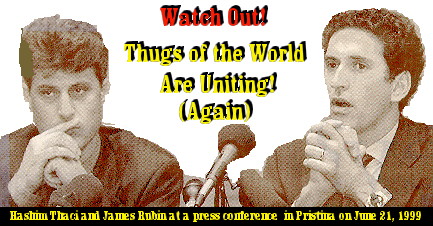
(1999), Hashim Thaci, a Kosovo Albanian who emerged as the UCK (Albanian abbreviation for Kosovo Liberation Army -
KLA) was a virtual nobody. A
few photo-op sessions later, in which Madeleine Albright kissed the
thug, and she and her spokesman, James Rubin, shook his hand and treated
him as a head of state, a virtual nobody became a virtual head of state
(see “Thugs
of the World Are Uniting (Again),” June 21, 1999). Just like Yasser Arafat.
At least that’s what an average American or Western European
citizen might have concluded.
emerged as the UCK (Albanian abbreviation for Kosovo Liberation Army -
KLA) was a virtual nobody. A
few photo-op sessions later, in which Madeleine Albright kissed the
thug, and she and her spokesman, James Rubin, shook his hand and treated
him as a head of state, a virtual nobody became a virtual head of state
(see “Thugs
of the World Are Uniting (Again),” June 21, 1999). Just like Yasser Arafat.
At least that’s what an average American or Western European
citizen might have concluded.
Well, the New York Times is at it again. This time, it is providing its terrorist-to-statesman PR services to an UCK offshoot in Macedonia, where a “peace farce” agreement has just been signed (see Item 1 of this TiM Bulletin). Ali Ahmeti, also a virtual nobody until the fighting in Macedonia broke out earlier this year, is an Albanian terrorist, like Thaci in service of the New World Order, whom the Times is now spinning as a future Macedonian statesman (see “Shadowy Rebel Assures Macedonia That He Seeks Peace,” Aug. 17).
The PR pattern is unmistakable. A “mysterious” and “enigmatic” figure emerges from the shadows of the rebel world (read the CIA or other spook agency’s world - the latter, of course, is never mentioned in the Times stories), to carry the torch for an ethnic minority (Albanian) cause.
Despite its biased reporting, however, the Times sometimes provides useful confirmations of our analyses and theories. Here’s, for example, what its Aug. 17 report says about Ahmeti’s dealings with the NATO brass:
“But
since then, to the ire of Macedonians, Mr. Ahmeti has become a regular
partner for negotiations with NATO leaders. Even today, four- wheel
drive vehicles carrying NATO officials and foreign diplomats climbed a
dirt road to this village, which is filled with armed guerrillas, their
supplies, a hospital, a mess hall and children wearing red N.L.A.
patches.
When
fighting flared to the edge of full-blown civil war, NATO leaders
regularly visited him and urged him to pull back his troops. And, given
the limits of heading what one diplomatic official today called a
"disparate" guerrilla group, officials say he has generally
kept his word.”
See that “NATO leaders regularly visited him”-line? Now go back and reread our Foreword, written a couple of days ago.
For now, Ahmeti is still donning his (German/NATO-made) military garb (see the photos). In the next phase, however, stand by for a shirt-and-tie image, just like Thaci’s. Ahmeti will then be posing for pictures surrounded by adoring children (“Just like his Marxist idols, Thaci hugs children by day while murdering by night,” read our caption of his June 25, 1999 photo).
As with most things, however, you get what you pay for.
While the New York Times PR service appears to be free and voluntary, it is not
necessarily very good. In
fact, it is quite sloppy at times...
appears to be free and voluntary, it is not
necessarily very good. In
fact, it is quite sloppy at times...
Take a look at the two Ahmeti images here. In the one on the left, Ahmeti is shown at the Times web site with the Albanian double-headed eagle crest on the wall behind him. The photo on the right, however, which was carried only in the print edition, clearly shows the UCK letters above the crest.
In other words, the Albanian NWO mercenaries in Macedonia don’t even bother to hide the Kosovo insignia under which they exterminated the Serbs from that Serbian province. Is that why the letters UCK have been cropped from the Times’ web edition photo?
A coincidence? Only for the uninitiated. Check out “The New York Times Lies and Distorts - Again and Again…” (Feb. 5, 2000). This TiM Bulletin provides two additional examples of image and truth manipulation by the Times. This included switching the identity of victims (from Serbs to Croats), such as in a 1993 example provided in that last year’s TiM Bulletin.
-------------
4.
U.S. to Fund Macedonia Media BlitzAug.
17, 2001
WASHINGTON, Aug. 17 - Just in case you may have thought that the New York Times went out on a limb with its today’s pro-Albanian terrorists media campaign, take a look at the front page story in today’s Washington Post, the Times’ ideological globalist/liberal brethren. Headlined “U.S. to Fund Macedonia Media Blitz,” the Post article clearly illustrates how the New World Order media carry out the brainwashing of both domestic and overseas masses. Here’s an excerpt:
“The
U.S. government is planning to finance an extensive political advertising
and lobbying campaign here in the next 45 days to secure parliamentary
passage of a peace deal that would expand the rights of the ethnic
Albanian minority, but is regarded with skepticism by Macedonian political
parties and the public, according to sources here and in Washington.
The
United States could spend up to $250,000 -- a significant amount of money
for a media campaign in this country of 2 million people (Macedonia) --
buying radio, television and newspaper advertisements. U.S. officials are
also considering direct mailings to every household, which would be the
first such effort in this Balkan country.
The
campaign, which could be launched in the next few days with radio spots,
will be coordinated with the office of Macedonia's president, Boris
Trajkovski. His advisers will work with Western strategists to fashion a
message that could change week to week, as in an election campaign. Local
advertising agencies will be hired to translate the strategy into a viable
media campaign. Trajkovski's involvement is regarded as critical, because
U.S. officials say they are nervous that the project will be construed as
interference.” […]
---
TiM Ed.: Fancy that! U.S. officials are “nervous” because the truth may come out?
---
“The
International Republican Institute (IRI), a Washington-based nonprofit
group that is partially funded by the U.S. government, has commissioned a
nationwide voter survey with 35 questions, mostly about the peace
agreement. The results of the survey, expected in the next few days, will
allow Western consultants and presidential advisers to tailor what they
are calling "public service announcements" to legislators and
the public.
IRI was
heavily involved with the media campaign of Otpor, the Serbian student
movement that helped defeat Slobodan Milosevic in Yugoslavia's
presidential elections last year.” […] (TiM Ed.: Check out "How
Washington Bought Yugoslav Presidency," Dec. 12, 2000).
The
United States is also considering flying members of parliament,
particularly members who are hostile to the accord or uncertain about how
they will vote, to some American states, possibly California or Texas, to
see how bilingualism works in those places; one of the most controversial
aspects of the agreement is the elevation of Albanian to the status of a
second official language.
A
secondary motivation for the effort, sources said, is to restore the
domestic standing of Trajkovski, a Western ally who was elected with
cross-community support, but whose approval rating has plummeted in both
the Macedonian Slav and ethnic Albanian communities. Macedonians blame him
for not forcefully pursuing a military option and stamping out the rebels;
ethnic Albanians blame him for the military force that was employed.”
For the full Post story, check out “U.S. to Fund Macedonia Media Blitz,” Aug. 17, 2001.
-------------
5.
“Canadian Trinity:” Ottawa to Send Only Three Soldiers to MacedoniaAug.
17, 2001
OTTAWA, Aug. 17 - Giving a whole new meaning to the word “trinity,” Canadian government is to send only three soldiers as NATO “peacekeepers” to Macedonia, according to an Aug. 17 Reuters news report, also carried by the Canadian CTV network. Canada said it’s only sending three people because that’s all that NATO requested.
“Canada is providing staff officers with considerable experience and the right qualifications for this NATO operation,” Minister of National Defense, Art Eggleton, said in a statement.
The “Canadian trinity” contingent is expected to
arrive in Skopje on Monday (Aug. 20).
But NATO said today (Friday) it would defer deciding when to deploy the
3,500 troops to the Balkans until next week.
It said recent clashes, in which a Macedonian police officer was
killed by the Albanian rebels on Thursday (Aug. 16) in Tetovo, “threaten
a delicate ceasefire which it said must be in place before NATO troops can
be sent.”
NATO announced earlier this week it would send in an
advance team of 400 British soldiers ahead of a planned 3,500-troop
incursion.
For the full story, check out CTV News, Aug. 17, 2001.
-------------
6.
Brazilian Judge Says Hague Tribunal Is “Partial”Aug.
17, 2001
RIO DE JANEIRO, Aug. 21 - A Brazilian judge, who sits on the bench of The Hague International Court of Justice, termed The Hague War Crimes Tribunal's handling of the Serbs accused of war crimes as “partial,” in an interview with the Rio de Janeiro’s newspaper O Globo, published on Monday, Aug. 20. Judge Francisco Rezek also said that the Yugoslav Tribunal costs 10 times more than the International Court of Justice, and that most of its expenses are paid by the United States.
The interview, conducted by O Globo's reporter Trajano de
Medeiros, was translated for TiM by a Brazilian reader who wishes to
remain anonymous, but whose identity is known to TiM.
This reader also told us that Judge Rezek was Justice at the
Brazilian Supreme Court, from 1893 to 1990, then Minister for External
Affairs (Foreign Minister), 1990-1992, Chief Justice, and appointed to the
International Court of Justice, at The Hague, in 1997.
Here’s the interview:
“O
GLOBO: Mr. Slobodan Milosevic's imprisonment at The Hague, the
condemnation of a Serb-Bosnian general for genocide, and the imprisonment
of Bosnian Muslim officers, are those facts an irreversible sign of
globalization of Justice?
REZEK:
It is one step for the universal Justice for grave crimes, crimes
defined by International Law, crimes against Mankind and war crimes.
O GLOBO:
Do you believe that Milosevic's judgment will be a peaceful (fair?) one?
REZEK:
The judgment will be not be immune to criticism.
O GLOBO:
Why not?
REZEK:
Milosevic asserts that the Court was created only to judge the Serbs; that
certain countries wanted that way - to judge certain persons from the Serb
side, in the context of the ex-Yugoslavia civil war.
O GLOBO:
Do you agree?
REZEK:
The Tribunal is juristically legitimate as the UN Security Council,
which has power to create any transitional organ, created it. (But)
for establishment of a permanent (judicial) organ, only the (UN) General
Assembly (is entitled to do it). Nevertheless, the Security Council
accomplished in the beginning of the 90's to create the Tribunal. Even
though, France was more active than the US, the US government pays the
largest part of the bill.
O GLOBO:
What do you mean?
REZEK:
It is quite a high bill. The
Criminal Tribunal for the ex-Yugoslavia costs to the UN approximately 10
times more (!) than the cost of the International Court of Justice that judges litigation between nations. (emphasis
added by TiM).
O GLOBO:
What is wrong with the Court?
REZEK:
It is composed of competent jurists, and it judges people accused of very
serious crimes. However, it is somewhat partial, which causes bad feelings
among observers and specialists. One does not need to leave Europe to find
other contexts of civil war in which people want to see others accused. If we leave Europe to go to Asia and Africa, we will see
situations, which will call for an international court.
O GLOBO:
Is that what the Serbs say?
REZEK:
It is not only the Serbs who say so in Belgrade. Many specialists around
the whole world think that those things cannot be made in such a way, in a
partial way, in an incomplete way. Why a court for Yugoslavia, and
another for Rwanda, if they are not the only contexts where you may
identify crimes against Mankind?
O GLOBO:
Why is the way out, then?
REZEK:
This will take us to the Treaty of Rome, of three years ago. The
happenings in Yugoslavia may take the countries responsible for the
creation of this specific court to support the creation of the tribunal
conceived by the Treaty of Rome. We
all know that we cannot deny the validity of some criticism made about
these specific tribunals, created to judge criminals, but they are
one-sided. Those courts are not an example because of the lack of
universality.”
---
TiM Ed.: So there you have it… straight from the mouth of a judge at The Hague. The only thing missing in Judge Rezek’s criticism of the Tribunal was the attribute we gave this “judicial” venue years ago - “kangaroo court.”



Also, check out... Djurdjevic's WASHINGTON TIMES columns: "Christianity Under Siege," "Silence Over Persecuted Christians", "Chinese Dragon Wagging Macedonian Tail," "An Ugly Double Standard in Kosovo Conflict?", "NATO's Bullyboys", "Kosovo: Why Are We Involved?", and "Ginning Up Another Crisis"
Or Djurdjevic's NEW DAWN (Australia) magazine columns: "Macedonia: Another Farcical American Oil War," "Anti-Christian Crusades," "Blood for Oil, Drugs for Arms", "Washington's Crisis Factory," and "New Iron Curtain Over Europe"