|
Momcilo Krajisnik, Loving Father
I met with Momcilo Krajisnik, the Speaker of the Bosnian Parliament,
at the end of a long day in May 1994. I was on my way back to Serbia. As
we sat down facing each other across a large conference table at his
office, I told Krajisnik about the Easter services that
year in Phoenix, when the St. Sava church was so full that the crowd
overflowed into the yard.

"See what happens when the Serbs get scared?," I joked,
trying to lighten up the conversation.
"They remember their church."
Krajisnik's eyes lit up. He
proceeded to talk with almost a Messianic zeal about the Bosnian Serbs'
cause.
"All Serbs should
know that we are building a new Serbian state here," he said.
"That's why we must get it done right.
Which means that both democracy and our religious traditions must
be respected."
Krajisnik paused and smiled. It
was evident that he had just recalled something.
"During the session of our National Assembly in May 1993 (held
to decide about the Vance-Owen plan - right photo), we had all sorts of dignitaries
here," Krajisnik said. (The Greek Prime Minister) "Mitsotakis was he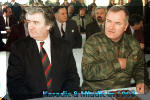 re;
(Slobodan) Milosevic (Serbia's president) was here; (Dobrica) Cosic
(Yugoslav president) was here... And so was a
Bosnian Serb bishop." re;
(Slobodan) Milosevic (Serbia's president) was here; (Dobrica) Cosic
(Yugoslav president) was here... And so was a
Bosnian Serb bishop."
(Cosic and Milosevic were both former Communists and self-declared atheists).
Nevertheless, "we insisted on carrying on all our
traditions," Krajisnik said. "Which
meant we kept getting them up on their feet quite often.
First, when the national anthem was played.
Then, when the Bishop said the Lord's prayer before dinner.
Being of Orthodox faith, Mitsotakis, of course, took part in
everything with enthusiasm. But
we noticed that ,although Cosic and Milosevic got up, they never crossed
themselves."
Then dinner was then served.
After the desert, the Bishop was getting ready to say another
prayer, to thank God for the food they had just received. That's when Milosevic got antsy.
He leaned toward Krajisnik and said, "Look at the priest
("pop") fidgeting! He
is getting ready to make us get up again."
:-)
I told Krajisnik that I'd had a similar experience during my last
meeting with Milosevic in February 1992.
As we were trying to coordinate our schedules, his Communist-secretary Mira, told my assistant, "Oh yes. I remember. Mr.
Djurdjevic has a meeting with the priest ("pop") at 6 p.m."
The “priest” (“pop”) was none other than Patriarch Pavle,
the head of the Serbian Orthodox Christian Church.
That would be like calling the Pope a monk. (Which is
actually not inaccurate).
"As they say in English - 'like father, like son,'" I
said. "Except that, in
this case, it's more 'like boss, like secretary.'"
Krajisnik smiled and nodded in agreement.

At one point, Krajisnik's secretary Milena, entered the room with a
camera in hand.
"I hope
you don't mind if she takes a picture of us as a souvenir?,"
Krajisnik asked. .
After Milena took the picture, I asked her to do the same using my
camera. She obliged (right picture).
When she left, Krajisnik said
that he was an economist by training, who specialized in
financial analysis.
He also said that he had three children.
His wife had died during the war.
She suffered a broken leg in a mine explosion.
The wound got infected which led to a blocked artery.
And since the Serbs didn’t have adequate health care services
under war conditions, she was gone before anyone could save her (also see "How
Ordinary People Became Extraordinary Heroes" for more on poor wartime medical services in the Bosnian
Serb Republic).
As I was leaving his office, Krajisnik introduced me to his three
teenage children who were waiting outside.
Their names are Njegos, Milos and Jagoda. The way they looked at Krajisnik with adoring eyes said it
all about how devoted a father he must have been, despite being a single
parent during war and his state duties.
Outside, dark clouds which had been gathering all afternoon had
turned to rain.
"When do you go back?" Krajisnik asked me.
"This evening," I replied.
Krajisnik suddenly became agitated. "In that case, please leave right away.
The front lines are quite close to the road in some places.
It really isn't wise to travel at night.
The last thing we need is that something, God forbid, would happen
to you while you're our guest here."
He paused as if reflecting upon what he had just said.
Then he shook his head. "No,
you should definitely leave without delay."
He spoke like a man who is more concerned more about the
welfare of his guest than about his own.
You see, Krajisnik himself had just come through those allegedly
dangerous stretches of the road (albeit in daylight) to meet me.
Krajisnik was found guilty of war crimes in March 2009 and
sentenced to 20 years in prison. The court decision is
currently on appeal. He is serving his sentence in Great
Britain. |

 GLOBAL



 n
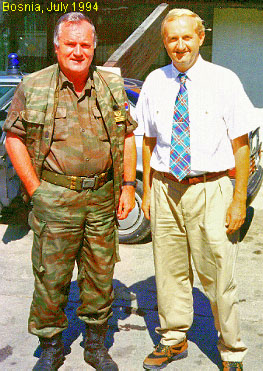
I first met the former top military commander of the Bosnian
Serb army in July 1994, Ratko Mladic looked as sunburned as if
he had just gotten off a Hawaiian surfboard (left shot). I asked
around what he had been up to.
n
I first met the former top military commander of the Bosnian
Serb army in July 1994, Ratko Mladic looked as sunburned as if
he had just gotten off a Hawaiian surfboard (left shot). I asked
around what he had been up to.  politicians, join
him in a special Sunday project - scything the grass on Mount
Romanija. President Radovan Karadzic, vice president, the quite
frail and scholarly late professor Nikola Koljevic (right,
committed suicide in 1997), and about 100 other Bosnian Serb
political and military leaders, all took part in, what I
figured, was their version of "bonding" (together and with the
people).
politicians, join
him in a special Sunday project - scything the grass on Mount
Romanija. President Radovan Karadzic, vice president, the quite
frail and scholarly late professor Nikola Koljevic (right,
committed suicide in 1997), and about 100 other Bosnian Serb
political and military leaders, all took part in, what I
figured, was their version of "bonding" (together and with the
people).

